


Saying that a development is functional, healthy and well built is relatively simple. Demonstrating that these qualities were planned in the design, followed through construction and verified by an independent assessment is another story. It is precisely in this gap between promise and proof that GBC Condomínio certification begins to gain relevance for residential developers.
The real estate market has always depended on trust. Buyers acquire a product that may still be under construction and whose most important effects will only be felt after moving in. Water and energy use, thermal comfort, acoustic quality, material durability and how systems work can rarely be assessed on a visit to the show apartment, however careful.
At the same time, developers must present their projects to investors, financial institutions, partners and buyers increasingly attentive to asset performance. In this scenario, expressions such as “sustainable development” or “high-quality project” are starting to need the backing of clear criteria.
GBC Condomínio responds to this challenge by offering a benchmark specific to residential developments. More than granting a seal, the certification guides decisions, organizes evidence and submits the project to independent analysis. For the developer, this can mean greater technical security, better control over delivery and a more consistent way of communicating the development's attributes.
What GBC Condomínio certification is
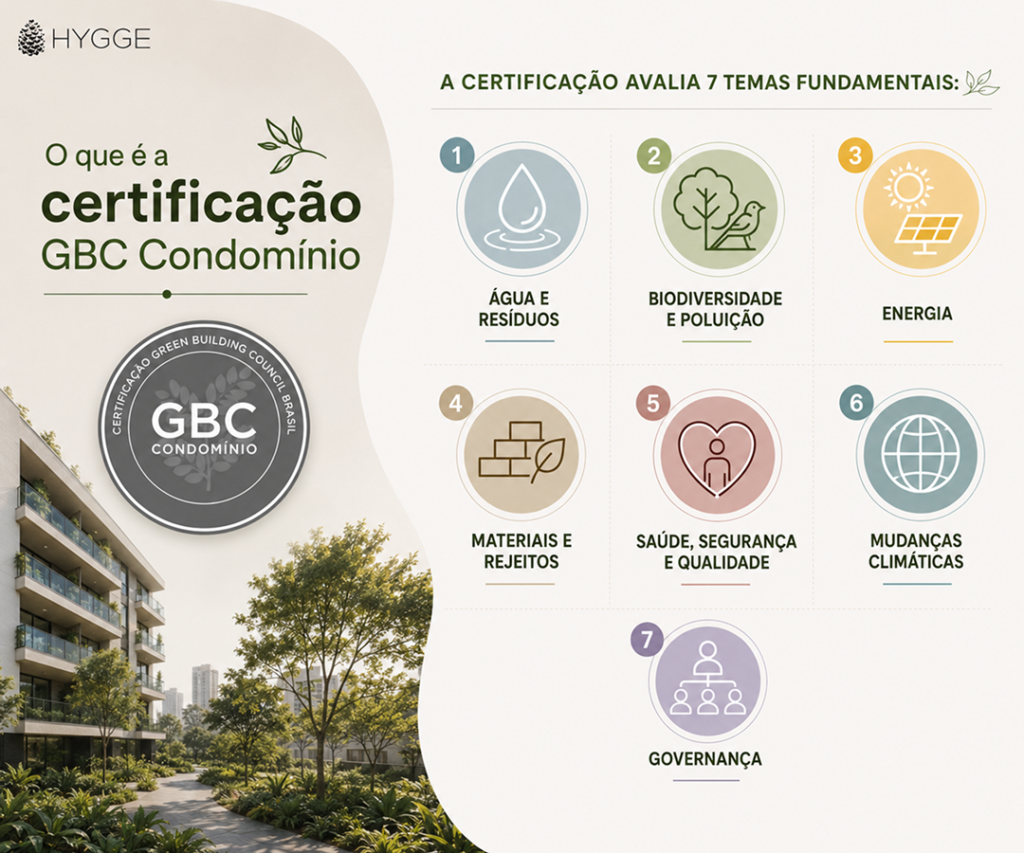
GBC Condomínio is a certification developed by the Green Building Council for residential developments. Its aim is to guide the design, construction and preparation for operation of the residential community through practices that reduce environmental impacts, increase efficiency and improve the product delivered to residents.
The assessment is not limited to checking whether the building has solar panels, green areas or water-saving devices. It analyzes a broader set of decisions that influence the development's performance, from the use of natural resources to the health, safety and comfort of its occupants.
In the latest version presented by GBC Brasil, the framework covers seven major fronts:
- Water and Waste;
- Biodiversity and Pollution;
- Energy;
- Materials and Waste Products;
- Health, Safety and Quality;
- Climate Change;
- Governance.
The process includes mandatory prerequisites, performance credits, supporting documentation and an independent audit. Developments can also achieve levels according to the score obtained.
This breadth helps to explain why the certification should not be treated merely as an environmental seal. It also looks at topics directly related to the quality of the real estate product, such as thermal, lighting and acoustic performance, air quality, system safety, commissioning and preparation for sustainable operation.
In practical terms, GBC Condomínio works as a social and environmental quality management framework. It sets criteria, requires proof and creates a verification process so that the characteristics presented by the developer do not depend solely on its own declaration.
GBC Condomínio: why this certification is entering the residential agenda
For a long time, sustainability certifications were associated mainly with corporate developments, company headquarters and large institutional projects. In these segments, operational efficiency and environmental responsibility were treated as relevant factors for occupants, investors and corporate tenants.
The residential sector took a different path. Much of its communication focused on location, floor plan, leisure and finishes. Sustainability appeared occasionally, usually associated with visible items or those easily summarized in sales materials.
This logic is changing because residential buyers have begun to feel the effects of development performance in their own routines. High building fees, hot rooms, noise between units, poor air quality and systems requiring constant maintenance have a direct impact on the experience of living there and on the cost of staying in the property.
There is also a change in the way developments are assessed by those who finance, invest or form partnerships. Environmental, social and governance issues no longer appear only in institutional reports and have begun to influence risk analysis, credit approval and the definition of investment criteria.
Certification does not, in itself, guarantee cheaper financing, faster sales or automatic appreciation. It can, however, strengthen how the development is presented by demonstrating that certain risks and indicators were considered in a structured way.
GBC Brasil itself links residential certification to reduced risks for investors and financial institutions, especially because the process documents practices related to resource use, waste management, operational performance and resident comfort.
For the developer, the relevance lies precisely in the ability to replace part of the discourse with evidence.
What GBC Condomínio assesses in practice

One of the difficulties in talking about certifications is that their criteria can seem abstract to those not directly involved in the process. In GBC Condomínio, each category seeks to address concrete problems in residential development and operation.
In Water and Waste, the aim is not just to install functional equipment. The design must consider water use, metering, reuse, disposal and management according to its context.
The Energy category includes aspects such as system efficiency, building performance, energy sources and the ability to track consumption. A solution can be technically sophisticated and still produce limited results if it is not connected to the project as a whole.
Biodiversity and Pollution extends the analysis to the site, the landscaping, the relationship with the surroundings and the reduction of impacts caused by the development.
Materials and Waste Products involves choices affecting origin, durability, environmental impact, occupant health, waste generation and site organization.
Climate Change considers the development's ability to respond to present and future risks, such as extreme events, intense heat, resource unavailability and changing environmental conditions.
Governance deals with how commitments, responsibilities, information and practices are organized so that sustainability does not depend only on an initial intention.
The Health, Safety and Quality category is especially relevant for developers that want to connect certification to the quality perceived by residents. It covers criteria such as air quality, natural light, acoustic control, thermal performance, system safety, potentially hazardous materials, water quality and access to green spaces.
This integrated view avoids a simplistic reading of sustainability. A residential community is not efficient just because it saves energy. Its performance depends on how resources, systems, materials, spaces and operation work together.
GBC Condomínio and certifications as a quality tool
The main strategic value of GBC Condomínio may lie less in the final seal and more in the process needed to achieve it.
A residential development brings together dozens of interdependent disciplines, suppliers and decisions. Architecture, building systems, structure, landscaping, interiors, budget, procurement and execution must move forward in a coordinated way. When performance criteria are addressed only at the end, incompatibilities, rework and more expensive solutions arise.
Certification creates a common reference. Teams begin to work with prerequisites, targets, responsibilities and documents. This helps identify earlier which strategies are viable, which need adjusting and which depend on monitoring during construction.
There is also an important effect on traceability. It is not enough to state that a given material has low impact or that a system was installed correctly. The process requires records, calculations, technical data sheets, reports…
This documentation strengthens the management of the development. When a decision has to be proven, there is a greater need to align specification, purchasing, execution and verification.
For the developer, there are three potential gains:
- Greater control over the promised quality and performance;
- Lower risk of strategies being lost between design and construction;
- The ability to present the development's attributes with external backing.
The certification process should therefore not be confused with the simple production of documents. Its function is to make the evidence match what was actually designed and built.
Is GBC Condomínio only for high-end developments?

The association between certification and the high-end market is still common, mainly because premium projects tend to have more financial room to incorporate additional solutions. But GBC Condomínio was not conceived exclusively for luxury residences.
The certification works with a variety of strategies, and many of them are linked to design quality, the efficiency of specifications and process organization, not necessarily to the inclusion of high-cost technologies.
In 2025, GBC Brasil announced the Gold certification of New Urban Residence in Curitiba, a building with 84 units and apartments sold for between R$500 thousand and R$800 thousand. The organization presented the case as proof that efficiency, comfort and sustainability can also be applied outside the luxury residential market.
This does not mean the certification is financially suitable for every project. The scope, budget, team maturity and commercial goals must be analyzed. The most important conclusion is another one: residential performance should not be treated as synonymous with sophistication.
Reducing waste, improving comfort, tracking consumption and protecting residents' health are relevant goals across different market segments. What changes is the strategy adopted to achieve them.
When GBC Condomínio makes sense
Certification tends to make more sense when there is a clear intention behind the process. Pursuing the seal only because competitors have started talking about sustainability can lead to decisions disconnected from the product.
The first scenario is when the developer wants to establish its own quality standard. In this case, the GBC Condomínio criteria help organize requirements that can be incorporated into future projects, creating internal learning and greater consistency across developments.
The second involves products that need to demonstrate differentiation in competitive markets. When location, floor area and leisure are similar, proof of efficiency, comfort and quality can broaden the sales argument.
Certification can also be relevant when the development will be presented to investors, funds, banks or partners that assess environmental, social, operational and reputational risks. Again, the seal does not replace financial analysis, but it offers an additional technical basis.
Another scenario involves projects that aim to reduce future operating costs. For this, the certification must be treated as part of the performance strategy, with choices that make sense for the climate, the use and the profile of the development.
There is also value when the developer wants to narrow the gap between marketing and delivery. By submitting certain promises to verifiable criteria, the company reduces the risk of using attributes that are vague or hard to sustain after occupancy.
The right time to start adopting GBC Condomínio

Although it is possible to assess projects at different stages, the earlier the certification is incorporated, the greater the ability to choose efficient strategies tends to be.
When the decision is made at the conception stage, the team can assess the site plan, orientation, envelope, systems, materials, green areas and operation in an integrated way. Many improvements can be made through design adjustments, without necessarily requiring expensive technologies.
When the process starts late, some strategies may depend on changes, new contracts or the replacement of solutions already defined. This raises costs and reduces the room for choice. Projects under construction can still pursue certification, but the risk of refusal is higher: all timber used must be certified and proven, as must earthmoving and waste. In other words, much of what has already been built without this guidance may become an obstacle.
Certification also requires coordination. The developer must define who is responsible, integrate the consultancy, designers, builder and suppliers and keep documentation up to date. Without this governance, the process risks becoming a fragmented hunt for evidence at the end of construction.
The aim is not to artificially adapt the development to a checklist. It is to use the certification framework to improve real decisions.
Why developers are looking at GBC Condomínio
Interest in GBC Condomínio follows a wider change in the residential market: quality is no longer just what the buyer can see.
Energy efficiency, rational water use, thermal and acoustic comfort, system safety, air quality and risk preparedness influence the experience, costs and durability of the development. Even when they do not appear in the show apartment, these factors become part of perceived value after occupancy.
Certification offers a structured way of developing and proving these attributes. For developers, this can support technical coordination, reduce uncertainty and improve dialogue with buyers, investors, banks and partners.
The key word, however, is coherence. GBC Condomínio makes sense when it is connected to the development's positioning, the audience's expectations, the available budget and the developer's goals.
This ability to prove the development's attributes in practice also opens a financial door. Developments with GBC Condomínio certification gain access to green financing (or green credit) lines, on more favorable terms than traditional models. Banks such as Santander already offer credit covering up to 100% of construction costs, with funds released from just 1% of the project's physical progress, far less than the 10% normally required in conventional financing, which ensures greater agility right at the start of construction. Added to this are more competitive rates and better payment terms, reducing the cost of capital for the development as a whole.
Hygge: turning performance into residential value through GBC Condomínio
Promising efficiency and quality is no longer enough when buyers, investors and financial institutions are looking for clearer evidence of development performance. Without an integrated strategy, important requirements may be noticed too late or get lost between design, contracting and construction.
Hygge supports developers, builders and design teams in structuring more efficient, comfortable and responsible developments. The consultancy works on interpreting the GBC Condomínio criteria, defining strategies, coordinating evidence and providing the technical monitoring needed for the certification process.
Want to understand whether GBC Condomínio makes sense for your next residential development? Talk to Hygge and assess the opportunities at the early stages of the project.

