

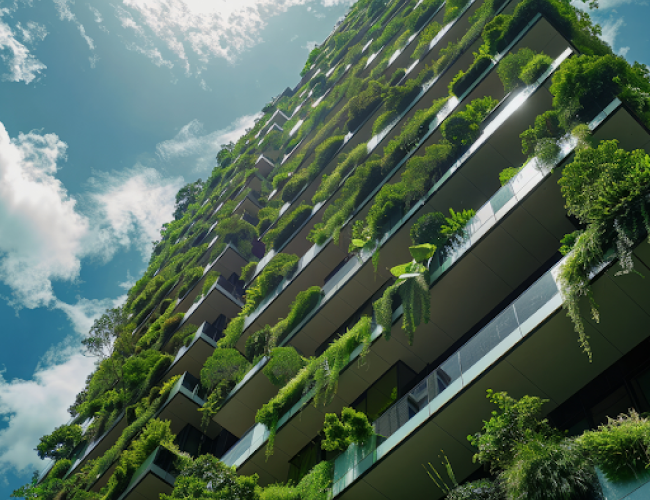
More than delivering a building, construction has taken on a decisive role in how people live, work and relate to spaces, and healthy buildings are no longer a trend: they now represent real value for the real estate market
For a long time, the quality of a development was measured almost exclusively by tangible aspects. Prime location, construction standard, finishes, built-in technology and leisure areas have always been at the center of design decisions and sales arguments. These factors are still important. But they are no longer enough to explain why some developments attract greater interest, achieve better appreciation and build a perception of quality far above that of technically similar competitors.
The market has come to recognize another element, less visible but increasingly decisive: the experience provided by the built environment.
Construction is at a point where a building's performance is no longer judged only by its engineering. It also depends on how the space influences the comfort, health, productivity, well-being and quality of life of those who use it every day.
This shift represents an important transformation for developers, builders, architects and all the professionals involved in creating developments.
When building came to mean caring for people
The COVID-19 pandemic accelerated a change that had already been happening quietly. Millions of people began to spend far more time at home or in their workplaces. The relationship with buildings changed. Issues that used to go unnoticed became part of the daily routine.
Ventilation quality was no longer a technical detail. Natural light began to directly affect productivity. Outdoor areas took on new meaning. Shared spaces came to represent quality of life, not just leisure.
The very concept of comfort was broadened. It is no longer enough for a building to be beautiful or functional. It is expected to contribute to a healthier routine. This shift changed consumer behavior and, consequently, the logic of the real estate market.
Today, buyers and investors look at attributes that, just a few years ago, rarely appeared among the main decision criteria.
The quality of a building goes far beyond the structure
When we talk about construction, it is natural to think of concrete, steel, building systems and structural performance. All of this remains essential. But a building only fully fulfills its function when it provides a good experience for the people who spend time in it.
After all… nobody buys just walls. People buy comfort. They buy peace of mind. They buy quality of life. They buy the expectation of living or working in an environment that supports their well-being every day.
This perception means that elements such as thermal comfort, natural light, ventilation, acoustic control, integration with green areas, internal mobility and the quality of shared spaces are no longer add-ons to the design and have become part of the product itself.
In other words, construction no longer delivers only infrastructure. It delivers experiences.
The growth of healthy buildings
This movement is not happening only in Brazil. In recent years, the concept of Healthy Buildings has gained strength in the international market by bringing together evidence that the built environment has a direct influence on people's physical, mental and emotional health. At the same time, so-called Wellness Real Estate has established itself as one of the fastest-growing segments in the global real estate market, reflecting growing demand for developments able to offer more than quality infrastructure.
The principle is relatively simple: designing spaces that promote health, comfort and well-being improves the user experience and, at the same time, makes developments more exclusive. This approach considers factors that remained in the background for many years, such as indoor air quality, lighting suited to the biological rhythm, thermal and acoustic comfort, encouragement of physical activity, integration with green areas, environments that foster social interaction and spaces for rest and mental recovery.
None of these attributes replaces the technical quality of construction. On the contrary: they add to its value, complementing engineering with a dimension that now directly influences how people perceive and choose a development.
Experience has come to influence perceived value
There is an increasingly evident phenomenon in the real estate market: two developments can have similar construction standards and still create completely different perceptions among buyers. This difference rarely lies only in the quality of the finishes. Most of the time, it lies in the experience the building provides from the first contact.
When someone visits a well-lit, quiet, thermally comfortable space, surrounded by vegetation and with areas that invite people to stay, the perception of quality arises even before any rational analysis. The environment conveys care, planning and well-being, building a connection that goes far beyond the technical characteristics of the design.
This experience directly influences the development's perceived value, and perceived value is one of the factors with the greatest impact on sales speed, asset appreciation and competitive positioning in the market. That is why more and more developers understand that investing in environmental quality does not simply mean improving the architectural design, but strengthening the real estate product itself and expanding its capacity for differentiation.
Architecture and construction are moving in the same direction
For many years, there was a relatively clear separation between what was the responsibility of engineering and what belonged to the world of architecture. Today, this division makes less and less sense. Contemporary projects require integrated work, in which construction, architecture, landscaping, environmental comfort and urban planning complement one another to create buildings that are more efficient and, above all, better for people.
This approach puts the user at the center of design decisions. The question is no longer only “how do we build?” and now includes an equally important one: “how will people live in this space?”. It is precisely this change in perspective that sets apart developments able to remain relevant for many years from those that compete only on location, floor area or finish standard.
In a market increasingly driven by experience, building well means, above all, creating environments that contribute to a better life.
Sources
Fabricio Lucchesi – Director of Hygge Engenharia
Forbes Brasil
Contact
contato@hygge.eco.br
+55 (41) 3779-0350
@hygge.eco / https://hygge.eco.br/